
Umwelt and Shattered Soap Bubbles of Perception
Unveiling the Interconnected Web of Perception

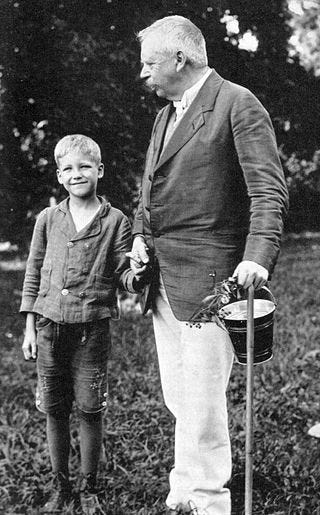
Jakob von Uexküll, a Baltic-German biologist who lived from 1864 to 1944, is considered a pioneer in the field of ethology, the study of animal behavior. His most significant contribution to the scientific world was the concept of Umwelt, a term that revolutionized our understanding of how organisms perceive and interact with their environment.
The Separation of Humans and Their Environment
In the early 20th century, the prevailing scientific view was that the world existed as an objective reality, independent of the observer. This perspective often led to a separation between humans and their environment, with humans seen as superior observers of a world that existed "out there." Von Uexküll challenged this view, arguing that the environment is not a single, objective entity but is experienced subjectively by each organism.
For instance, consider a flower meadow. To a human, it might be a beautiful sight, a place for a picnic, or a source of inspiration. To a bee, the same meadow is a buffet of nectar and pollen. To a cow, it's a source of food. Each organism, with its unique sensory apparatus and biological needs, perceives and interacts with the meadow in a fundamentally different way.
Umwelt: The Organism's Subjective World
Von Uexküll coined the term Umwelt to describe this subjective world of an organism. The Umwelt is not simply the environment as it exists physically but is the environment as it is experienced and interpreted by the organism. It is the world that is meaningful to the organism, shaped by its sensory capabilities, its biological needs, and its evolutionary history.
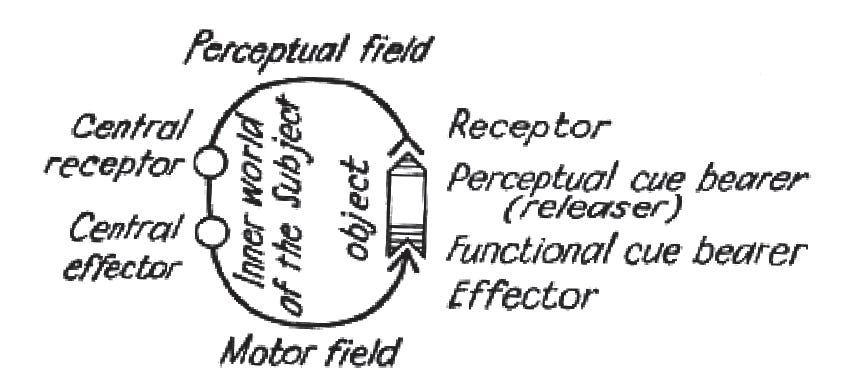
Every organism occupies its own particular world (Umwelt), which is a selection and construction of the world as a whole (Natur). Understanding the unique characteristics of different organisms’ Umwelten—how different organisms construct their world—was the hallmark of Jacob von Uexküll.
The concept of Umwelt was variously described by him as a “subjective universe,” “phenomenal world,” or “self world.”
Von Uexküll (1992, p. 319) has us imagine a kind of “soap bubble”, surrounding every organism in their interactions with Natur. The principle guiding each organism determines what properties of Natur will be deemed meaningful, that is which will be refracted to them through their soap bubble. To reconstruct an organism’s Umwelt within our own is to get at the principle guiding its life-course.
The Umwelt of a tick, for example, is incredibly simple. It consists primarily of the smell of butyric acid, a chemical exuded by mammals, and the sensation of warm blood. These are the only aspects of the environment that are relevant to the tick's survival and reproduction.
The odor of butyric acid, which is given off by the skin glands of all mammals, gives the tick the cue to leave its watch post and leap off. If it then falls onto something warm—which its fine sense of temperature will tell—then it has reached its prey, the warm-blooded animal, and needs only use its sense of touch to find a spot as free of hair as possible in order to bore past its own head into the skin tissue of the prey. Though it has no sense of taste, the tick pumps a stream of blood, as long as it is warm, slowly into itself. Given the needs dictated by its internal state(s) at a scheduled point in its life cycle, three features become salient in the tick’s surrounding environment:
Odor of butyric acid
Hairy surface
±37°
Following a sequence, each of these three cues is perceived, defining a pattern that is identified and assigned a value—meaning—triggering the following pre-set behaviors:
Odor of butyric acid → leap off
Hairy surface → cling to it
±37° → pump the hosts blood
In contrast, the Umwelt of a human is vastly more complex, encompassing a wide range of sensory experiences, emotions, thoughts, and cultural influences.
Umgebung: The Environment Around the Organism
To further clarify the concept of Umwelt, von Uexküll introduced the term Umgebung. This refers to the objective environment, the world as it exists independently of any observer. It is the stage upon which the drama of life unfolds, but it is not the play itself.
The play is the Umwelt, the subjective world that each organism creates through its interaction with the Umgebung.
Umwelt in the Animal World
The concept of Umwelt is particularly illuminating when applied to the animal world. Consider the echolocation of bats. Bats perceive the world through a symphony of echoes, bouncing sound waves off objects to navigate and hunt. Their Umwelt is a world of sounds, a sonic landscape that is invisible to humans.
Similarly, the Umwelt of a dog is dominated by smells. Dogs have an olfactory system far more sensitive than ours, and they use this to navigate, communicate, and understand their world. Their Umwelt is a rich tapestry of scents, a world that we can only dimly imagine.
Umwelt and Human Perception
While the concept of Umwelt is most often applied to animals, it is equally relevant to humans. Our Umwelt is shaped by our sensory experiences, our cultural background, our personal history, and our individual personalities. It is the world as we perceive it, the world that is meaningful to us.
For example, a musician's Umwelt might be filled with sounds and melodies, while an artist's Umwelt might be dominated by colors and shapes. A scientist's Umwelt might be structured by theories and data, while a chef's Umwelt might be a symphony of tastes and smells.
Extending the Human Umwelt
Technology and science have given us superpowers, allowing us to peek into the secret Umwelten (sensory worlds) of animals, worlds previously invisible and inaudible to us. It's like unlocking hidden levels in a video game!
Take butterflies, for example. They see patterns on each other's wings in ultraviolet light, a color we can't see. But with special cameras, we can capture these patterns and translate them into colors we can see, like cracking a secret code!
We've even gone beyond the limits of our senses. Using the language of math, we can explore the Umwelten of genes and exploding stars, things we could never experience directly. It's like using a cheat code to see the invisible!
So, our reality isn't just what we see, hear, or touch. It's a constantly expanding universe, revealed through science and technology. It's a thrilling adventure, and we're just getting started!
Perception Soap Bubbles and Umwelt Overlaps: The Dance of Shared Worlds
Life is a vibrant tapestry woven from countless individual experiences, each a unique Umwelt, a personal bubble of perception. Yet, these bubbles are not isolated; they constantly intersect, overlap, and intertwine, creating a shared reality where our individual worlds meet. This phenomenon, known as Umwelt overlap, is the cornerstone of social interaction, cooperation, and even conflict.
Umwelt overlaps are not confined to the animal kingdom. They are the essence of human interaction. Our individual perception bubbles intersect in countless ways, shaping our relationships, our societies, and our understanding of ourselves. The overlap between a parent and a child, for instance, is a dance of love, learning, and shared experiences.
The overlap between colleagues at a SaaS company is a complex interplay of collaboration, competition, and shared goals. Imagine a sales representative and a software engineer at a fast-growing SaaS startup. Their Umwelten, seemingly worlds apart, intersect in their shared goal of customer satisfaction. The salesperson's Umwelt is filled with client interactions, market trends, and sales targets. The engineer's Umwelt is a landscape of code, algorithms, and system architecture. Yet, their worlds overlap in the shared space of the product they are building and selling. This overlap is where innovation happens, where customer needs meet technological solutions.
In the business world, understanding Umwelt overlaps is crucial. A company's success often hinges on its ability to align its Umwelt with that of its customers. This is where marketing comes into play, creating a shared space where the company's perception bubble intersects with that of its target audience.
Moment of Self Reflection
So, the next time you find yourself in a bustling crowd, a quiet forest, or a lively office, take a moment to ponder the invisible dance of perception bubbles around you. Each person, each creature, is experiencing their own unique Umwelt, yet these worlds are constantly overlapping, creating the rich tapestry of life we all share.
Your Umwelt, your perception bubble, is not just yours; it's part of a larger, interconnected whole. By understanding this, we can learn to navigate the world with greater empathy, understanding, and appreciation for the diverse perspectives that shape our shared reality.
While Jakob von Uexküll's Umwelt concept revolutionized our understanding of subjective realities, it's fascinating to explore how it intersects with Ross Ashby's concept of Eigen behavior, which you can delve deeper into in my post
