

Remember when software was predictable? When you could trace through your code line by line and know exactly what would happen? Those days are fading fast. We're watching a fundamental shift—from the deterministic world of traditional software to something far more alive, adaptive, and honestly, a bit wild.
The Ground is Shifting Beneath Our Feet
Here's what's happening:AI models drop like seasonal fashion collections. Each new release comes with its benchmark scores, and we immediately start stacking our tools on top—Python scripts, base prompts, MCPs, all wrapped in Cursor or Claude. Before we know it, these tools start talking to each other, creating loops we didn't explicitly program.
It's like watching software evolve into a living ecosystem. One day you're writing code, the next day your code is writing itself, guided by models that are themselves guided by... well, us, but also not quite us.
Welcome to the Era of Stack-ware
Think LEGO bricks. Not the instruction manual kind where you build a specific castle, but the massive bin of pieces that become whatever the season demands. Halloween? Those same bricks become a haunted house. Christmas? Now it's Santa's workshop.
That's what development looks like now. We're not building monoliths; we're assembling stacks:
Base model (pick your flavor)
Your bricolage layer (prompts, scripts, configurations)
Tools and wrappers (Cursor, Claude, whatever's hot this week)
The emergent behavior that somehow ties it all together
The fascinating part? The whole stack can be torn down and rebuilt for a different purpose tomorrow. It's not extinction – it's reconstitution.
When Your Code Starts to Swarm
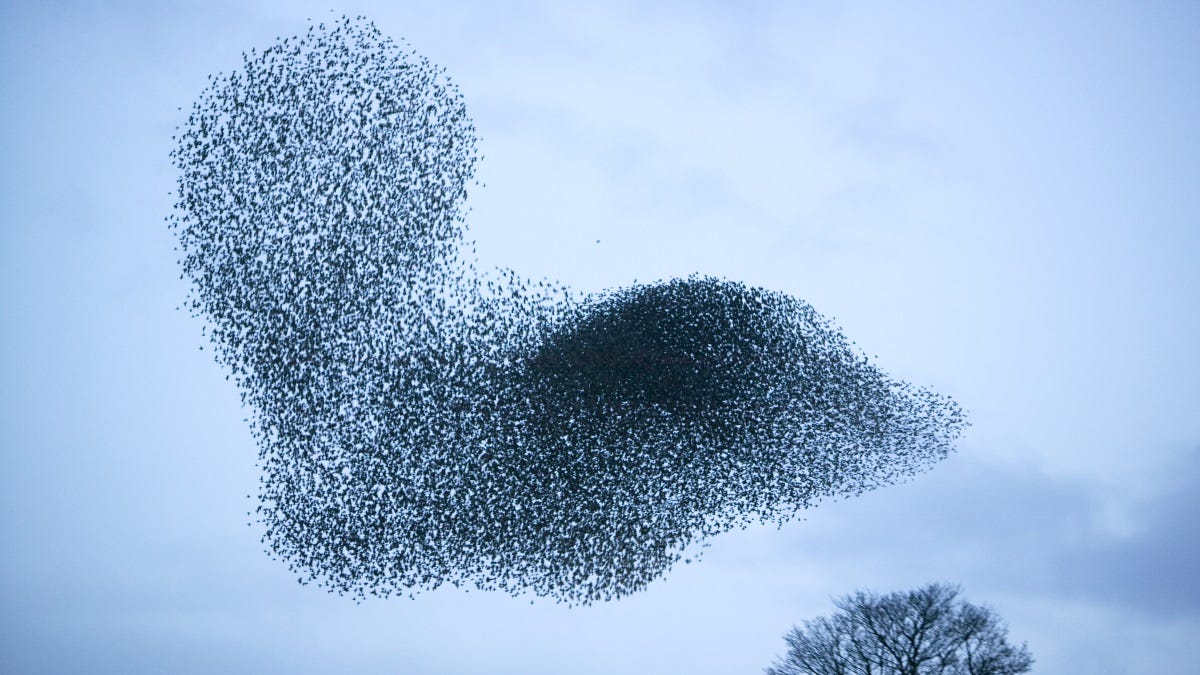
Watch a flock of starlings at sunset. No bird is following a master plan, yet they create these incredible, fluid patterns in the sky. That's increasingly what our software looks like. We set initial conditions, we guide outcomes, but what emerges often surprises us.
Your "peers" in this process aren't just other developers anymore. They're agents, models, and feedback loops that participate in the creative process. You prompt, they respond, you adjust, they adapt. It's a dance where neither partner fully leads.
Measuring Disasters When Nothing Holds Still
In the old world, a bug was a bug. You could trace it, fix it, test it. But how do you debug emergent behavior? How do you measure failure in a system that's constantly reshaping itself?
Maybe we need to think like seismologists studying earthquakes or meteorologists tracking storms. These aren't bugs anymore – they're events in a complex system. Sometimes small adjustments cascade into massive changes. Other times, what looks like a major shift gets absorbed without a ripple.
The Mirror Test for Modern Developers
Here's an experiment: Watch yourself work for a day. Really observe:
How often do you write fresh code versus prompt and adjust?
When you debug, are you fixing logic or negotiating with a model?
How many layers of abstraction sit between your intent and the final output?
If you're a product manager or executive, the shift might be even more pronounced. You're not managing features anymore; you're orchestrating capabilities that might manifest differently each time they're invoked.
Embracing the Probabilistic Future
The hard truth? We're all bricoleurs now – tinkerers assembling and reassembling pieces we half-understand into configurations that work until they don't. The deterministic, observable, predictable world of traditional software is giving way to something more organic.
But here's the beautiful part: Like those LEGO bricks that become a thousand different things, our stack-ware approach means we can adapt faster than ever. New model drops? Swap it in. Better tool emerges? Add it to the stack. User needs change? Reconfigure the whole thing over lunch.
We're not just writing software anymore. We're cultivating digital gardens where code, AI, and human intention intermingle in ways we're only beginning to understand. It's messier than the old way, sure. But it's also more alive, more responsive, more capable of surprise.
And maybe that's exactly what we need in a world that refuses to hold still.
What's your stack looking like these days? How are you navigating this shift from deterministic to probabilistic development? I'd love to hear how others are experiencing this transformation.
Very nice write up
May the FORCE BE WITH YOU.