

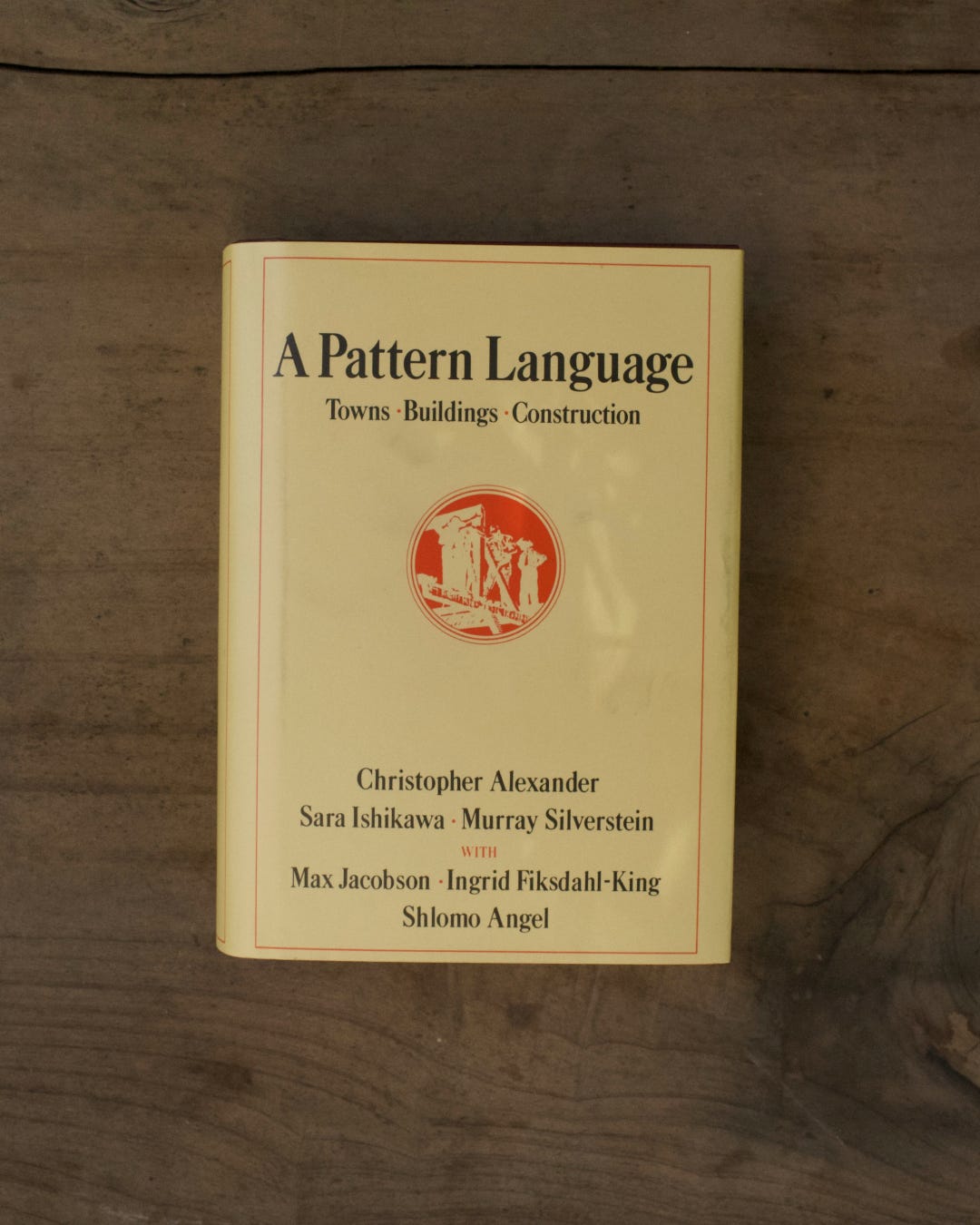
There's a moment that happens when you first read Christopher Alexander's "A Pattern Language" – it's like suddenly being given new eyes. You start noticing why certain spaces feel alive while others feel dead. Why some software flows naturally while other interfaces fight you at every turn. Why walking down one street feels inviting while another identical street feels hostile.
Alexander didn't just write an architecture book in 1977. He created a decoder for the hidden grammar of human environments. And in doing so, he accidentally revolutionized software design, interface development, and the way we think about absorbing complexity into elegant simplicity.
The Pattern Revelation
The genius of "A Pattern Language" lies in a deceptively simple idea: the problems we face in creating human environments repeat themselves over and over, and so do their solutions. But unlike rigid rules or formulas, Alexander documented these solutions as patterns – flexible templates that capture the essence of what works, while allowing infinite variation in how you apply them.
Each pattern describes a problem and then offers a solution, but not in the way you might expect. Take Pattern 159: "Light on Two Sides of Every Room." Alexander doesn't just say "put windows on opposite walls." Instead, he explains the deeper human reality: "This pattern, perhaps more than any other single pattern determines the success or failure of a room... Rooms lit on two sides, with natural light, create less glare around people and objects; this lets us see things more intricately; and most important, it allows us to read in the details of the minute expressions of the face."
See what happened there? He didn't give you a rule about window placement. He gave you the why behind the pattern – humans need to read facial expressions to connect with each other. Light from one side creates harsh shadows and glare. Light from two sides eliminates this problem. Once you understand the forces at play, you can solve this pattern in countless ways: skylights, interior windows, courtyards, glass doors. The pattern absorbed the complexity of human psychology, physics, and spatial relationships into a simple principle you could apply anywhere.
How Patterns Work Together
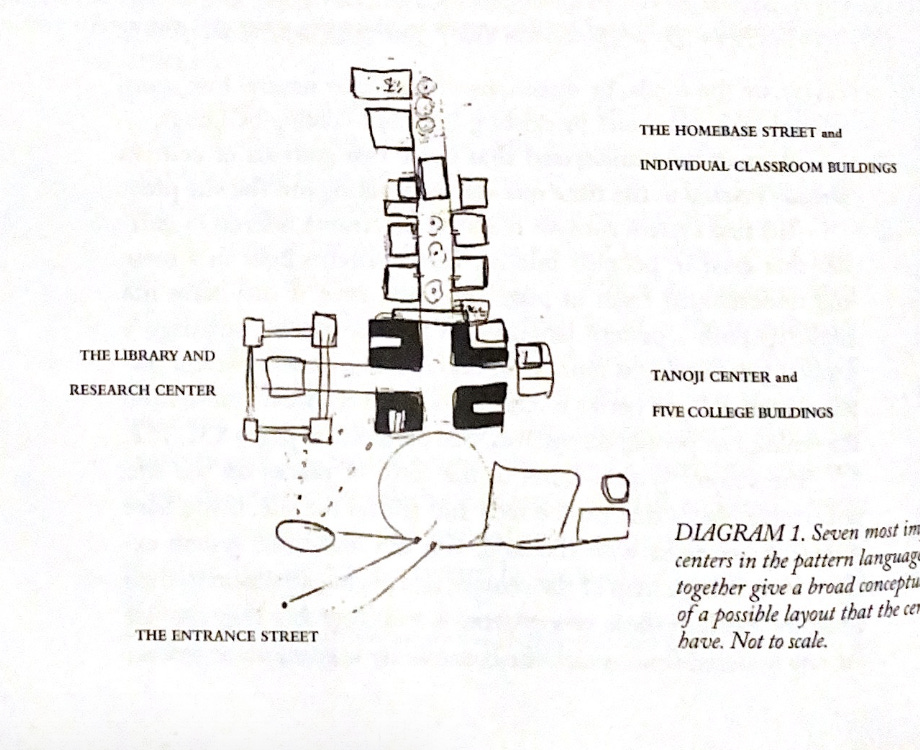
But here's where Alexander's real insight emerges. All 253 patterns together form a language – and like any language, the magic happens when elements combine. Individual patterns are like words; when they overlap and reinforce each other in the same space, they create something profound.
Consider how Pattern 106 (Positive Outdoor Space) might work with Pattern 163 (Outdoor Room) and Pattern 107 (Wings of Light). Instead of three separate solutions, you get buildings arranged to create courtyards that feel enclosed like rooms but open to the sky, with wings of the building shaped to bring natural light into adjacent indoor spaces. The patterns weave together, each one solving its own problem while supporting the others.
"Every building, every room, every garden is better, when all the patterns which it needs are compressed as far as it is possible for them to be," Alexander wrote. This compression – this ability to have multiple patterns occupying the same physical space – is how simplicity emerges from complexity. It's not about removing things. It's about finding solutions that serve multiple purposes simultaneously.
The Software Revolution
Here's what blew my mind when I first learned this: In 1987, Ward Cunningham was a software engineer working on new software approaches at Tektronix Corporation in Portland, Oregon. That year, he recalls, programmer Bill Croft sent him (and several other computer pioneers) a copy of Alexander's book A Pattern Language. Along with Kent Beck, they became obsessed with applying Alexander's ideas to software development.
What excited both Cunningham and Beck was just this: they thought they might have stumbled upon an idea that could convey this kind of delicate inter-relationship in their software, which would allow it to follow more closely the kinds of things that real human beings are interested in doing.
This led to the creation of design patterns in programming – reusable solutions to common problems in software design. But more importantly, it changed how programmers thought about building complex systems. Instead of trying to solve everything from scratch, they could identify recurring problems and apply proven patterns.
The same principle that makes a room feel alive with "Light on Two Sides" could make a user interface feel intuitive. The same pattern thinking that creates "Outdoor Rooms" could inform how you design navigation systems or information architectures.
The Interface Connection
Think about any app or website you love using. Chances are, it successfully implements dozens of invisible patterns that make it feel effortless. The way notifications appear exactly where you expect them. How buttons look clickable without needing labels. The way information is grouped so you can scan it naturally.
These aren't accidents. They're patterns – solutions to recurring design problems that have been absorbed into the interface so completely that they feel obvious. Like Alexander's architectural patterns, the best interface patterns solve multiple problems at once. A simple search bar can handle discovery, navigation, and task completion. A well-designed card layout can organize information, provide clear visual hierarchy, and create scannable content.
The pattern language approach teaches interface designers to look beyond individual elements to see the underlying forces at play. Why do users struggle with this form? What human needs aren't being met? How can we design something that feels natural rather than forced?
Reading the Environment
Once you start thinking in patterns, the world becomes readable in a completely new way. You walk into a coffee shop and instantly notice whether it has Pattern 241 (Seat Spots) – places to sit that face the activity. You use an app and feel whether it implements Pattern 159's digital equivalent – information visible from multiple entry points so you never feel lost.
You start to see why some Amazon product pages work perfectly while others feel cluttered – it's about pattern density and how well the patterns support each other. You understand why certain streets feel walkable while others feel hostile, even when they have the same physical elements.
Alexander gave us a way to decode the hidden grammar of environments – both physical and digital. He showed us that simplicity isn't about minimalism or reduction. It's about understanding the deep patterns that make things work and then layering them together until they feel inevitable.
The Art of Seeing
"Each pattern describes a problem which occurs over and over again in our environment, and then describes the core of the solution to that problem, in a way that you can use this solution a million times over, without ever doing it the same way twice."
This is the real gift of pattern language thinking. It trains you to see the underlying structure beneath surface appearances. To understand that great design – whether it's a medieval town square or a mobile app – isn't about following rules, but about recognizing and responding to deeper human patterns.
The cafe that draws you in doesn't just have good coffee. It implements patterns of human gathering that have worked for centuries. The software that feels magical doesn't just have clean visuals. It absorbs complex workflows into interactions that feel natural.
Pattern languages teach us that the best simplicity comes from deep observation. From watching how humans actually behave, what they actually need, how they actually move through spaces – both physical and digital. From understanding the forces at play well enough to create solutions that feel timeless.
Alexander gave us more than an architecture book. He gave us a way of seeing that reveals the hidden order in everything we design. And once you learn to see those patterns, you can't unsee them. The world becomes both more complex and more simple – complex in its intricate relationships, simple in its recurring solutions.
The next time you walk into a space that just feels right, or use an interface that flows perfectly, ask yourself: what patterns are at work here? What recurring problems have been solved so elegantly that they've become invisible?
Because that's the ultimate goal of any pattern language – to absorb complexity so completely that what remains feels like pure, inevitable simplicity.