
Cracking the Code of Complexity
From Coffee Machines to Corporate Chaos

In the fast-paced realm of life, we're bombarded with terms like "complexity" and "complicated" often used interchangeably. But if you were to ask the brilliant minds at the Santa Fe Institute, a haven for complexity science, you'd get a very different answer. They see the world in terms of systems, and each of those words represents a distinct category with unique characteristics and challenges.
Simple Systems: The Coffee Machine of Your Home or Organization
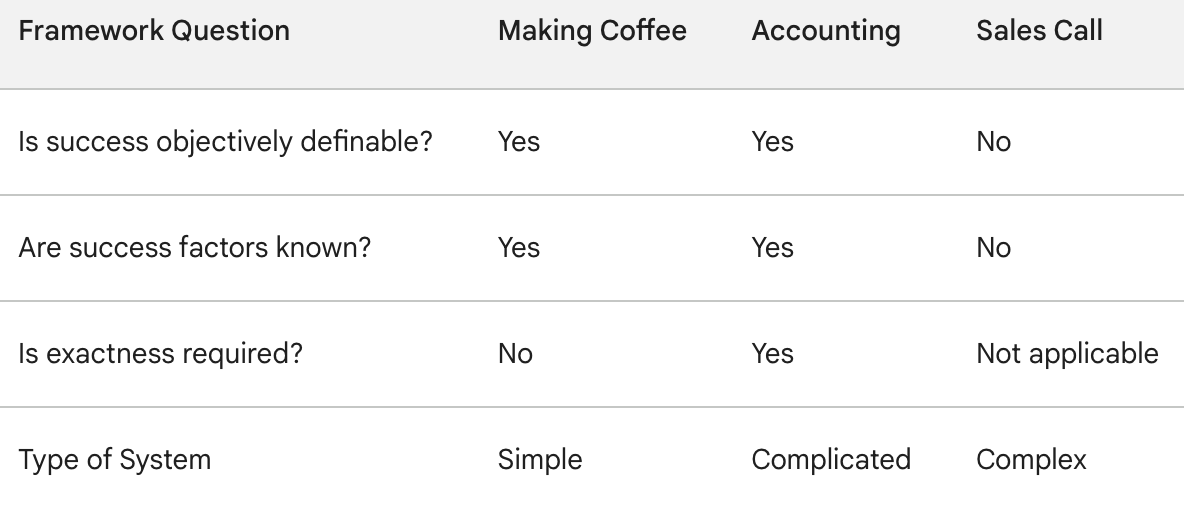
Think of your office coffee machine. It's a simple system. You know exactly when you've got a successful outcome (a steaming cup of coffee), there are clear instructions (push a button, maybe add grounds), and even if you don't follow those instructions perfectly, you'll probably still get a decent result.
Simple systems might include tasks like resetting a customer's password, generating a standard report, or sending out an automated email sequence. These are routine processes with predictable outcomes, often handled by well-defined workflows or even automation.
Complicated Systems: The Financial Statements of Your Organization
Now, imagine your company's financial statements. They're complicated. There's a right answer (no room for approximation), a strict set of rules and constraints to follow (accounting standards), and a high degree of reproducibility (every accountant should arrive at the same numbers).
This could be the intricate process of calculating your monthly recurring revenue (MRR), ensuring GDPR compliance, or implementing a complex integration with another platform. These tasks require expertise, adherence to specific and prescribed procedures, and leave little room for deviation.
Complex Systems: The Sales Dance of Your Organization
Let's talk about sales – that high-stakes ballet of human interaction where the goal is clear (closing the deal), but the choreography is anything but. It's a realm where those "10 Tips for Guaranteed Sales Success" articles on LinkedIn fall laughably short.
In the complex world of sales, every interaction is a unique dance. A pitch that dazzled one prospect might bore another. A discount that sealed the deal last week could be met with indifference on a time scale (beginning or end of quarter). It's not just about the product or the price; it's about personalities, timing, market sentiment, and a myriad of other factors that create an ever-shifting landscape.
Think of it as a jazz improvisation rather than a rehearsed routine. The skilled salesperson knows the basic scales and chords, but they also have the intuition to adapt to the moment, to read the subtle cues of the audience, and to create something new and unexpected. The best sales books don't offer formulas, but frameworks for understanding human psychology, building rapport, and navigating uncertainty.
But sales isn't the only complex system in your organization. Product development, marketing campaigns, even internal team dynamics – these are all arenas where simple cause-and-effect logic breaks down. They're ecosystems of interconnected elements, where small changes can ripple out in unexpected ways, and where the whole is often greater (or more chaotic) than the sum of its parts.
The Santa Fe Institute's work on complexity has shed light on these dynamics, revealing that complex systems aren't simply more complicated versions of simple ones. They have their own set of rules and characteristics, where emergent behaviors, feedback loops, and adaptive learning are the keys to success. Trying to manage a complex system with the same tools you'd use for a complicated one is like trying to play jazz with a metronome.
So, the next time you see a LinkedIn post promising "10 Foolproof Steps to Skyrocket Your Sales, or Close your prospect via Product Led channels in 5 days" take it with a grain of salt. Embrace the complexity of your organization, cultivate adaptability, and remember that sometimes the most valuable insights come not from following a script, but from listening to the music of the moment.
Can we in “simple terms” differentiate between Simple, Complicated and Complex
A overtly simplified representation would look like
Understanding the shape of Complex Systems: The Dance of Energy and Information
Now, let's delve deeper into the characteristics that define complex systems:
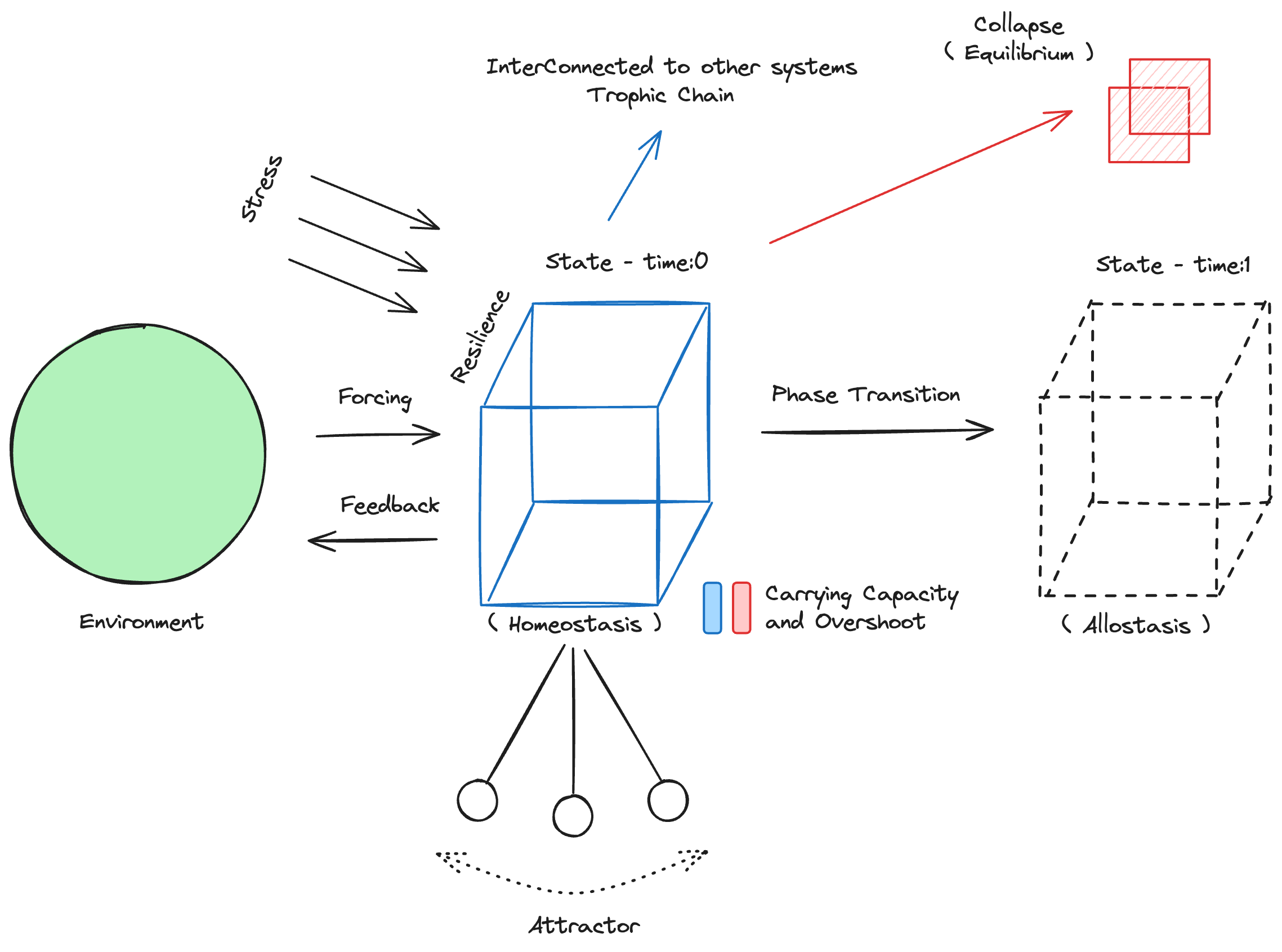
State: The snapshot of a system at a given moment in time. In an organization, this could be the current sales figures, employee morale, or market share.
Forcing: External events that nudge or perturb the system. A new competitor entering the market, a change in regulations, or a sudden economic downturn are all examples of forcing.
Feedback: The system's reaction to a forcing. Positive feedback amplifies the effect (e.g., a viral marketing campaign leading to exponential growth), while negative feedback attenuates or dampens it (e.g., increased production costs leading to price adjustments).
Attractor: A stable state the system tends towards. For a company, this could be a consistent level of profitability, a particular market niche, or a specific company culture.
Homeostasis (Resilience): The system's ability to maintain its state despite perturbances. A resilient organization can weather storms, adapt to change, and bounce back from setbacks.
Carrying Capacity: The maximum level of activity a system can sustain. For a business, this could be the maximum number of customers it can serve effectively or the maximum growth rate it can handle without compromising quality.
Overshoot: When a system temporarily exceeds its carrying capacity. This could be a period of rapid growth followed by a plateau or decline, or a sudden surge in demand that strains resources.
Phase Transition: A sudden shift from one state to another. A company might experience a phase transition when it pivots to a new business model, situates itself at another position in the curve, undergoes a merger, or faces a disruptive technological change. This leads to a new Attractor.
Tipping Point: The threshold that triggers a phase transition. This could be a specific market saturation point, a critical level of customer dissatisfaction, or a technological breakthrough that renders existing products obsolete.
Trophic Chain: The interconnected relationships within a system, where energy and resources flow from one element to another. In an organization, this could be the flow of information from leadership to employees, the exchange of goods and services with customers, or the financial transactions that sustain the business.
Collapse: A rapid and dramatic decline in complexity. This could be bankruptcy, a mass exodus of employees, or a complete loss of market share.
Understanding these dynamics is key to navigating the complexities of the modern business landscape. By recognizing the interconnectedness of your organization's elements, you can anticipate potential tipping points, foster resilience, and even harness the power of phase transitions to drive innovation and growth.
In Conclusion: Embracing the Dance
The world of business is not a static equation, but a dynamic dance of complex systems. By understanding the rhythms and patterns of this dance, we can become more adept at leading, innovating, and thriving in an ever-changing environment. The Santa Fe Institute's pioneering work in complexity science has given us the tools to decode this dance, revealing the hidden order within the chaos.
...And as for those who peddle "10 Foolproof Steps to increase ARR", “The best SaaS Pricing Strategy ..” or "Triple Your Sales in 3 Days"? Remember, complex systems defy such simplistic reductions. They're not coffee machines with a set of instructions; they're vibrant ecosystems where cause and effect dance in unpredictable patterns.
So, the next time you see a LinkedIn post promising a quick fix for a complex challenge, recall this shape above and its characteristics. Remember the distinction between simple, complicated, and complex. And don't be fooled by those who claim to have distilled the symphony of complexity into a three-minute jingle. Embrace the dance, not the dogma, and let the insights of complexity science guide you toward true understanding and sustainable solutions.